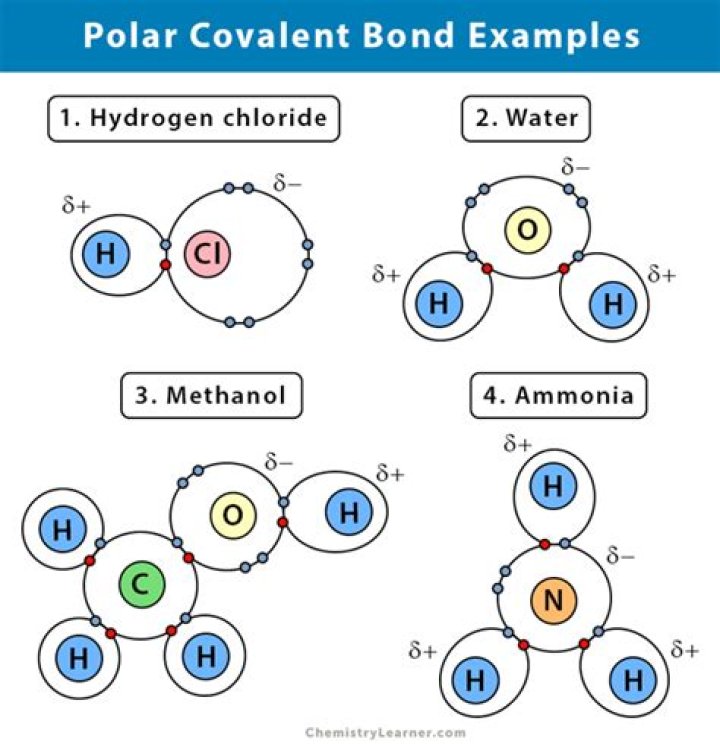
What are 5 examples of polar covalent bonds?
If the electronegativity difference between the two atoms is between 0.5 and 2.0, the atoms form a polar covalent bond….Polar Molecules
- Water – H2O.
- Ammonia – NH.
- Sulfur dioxide – SO.
- Hydrogen sulfide – H2S.
- Ethanol – C2H6O.
What is the combination of atoms in a polar covalent bond?
so, H and Br can form polar covalent compound.
What are polar covalent bonds give an example?
A water molecule, abbreviated as H2O, is an example of a polar covalent bond. The electrons are unequally shared, with the oxygen atom spending more time with electrons than the hydrogen atoms. Since electrons spend more time with the oxygen atom, it carries a partial negative charge.
What is polar covalent bond example?
Answer: Polar covalent bond is a type of chemical bond where one pair of electrons is shared unevenly between two atoms. For example, Hydrogen chloride (HCl) molecule. The bonding of hydrogen and chlorine atoms leans more towards Cl atoms because Cl is more electronegative in nature than hydrogen.
Which combination of atoms would form a nonpolar covalent bond?
If the electronegativity between two atoms is basically the same, a nonpolar covalent bond will form. For example, two atoms of fluorine each have the same electronegativity. Since there is no difference between electronegativity between the two atoms, they will equally share electrons forming a nonpolar covalent bond.
Which of the following molecules have polar covalent bonds?
The molecule that contains a polar covalent bond is c. H-F because it consists of fluorine and hydrogen atoms which have electronegativity differences…
Which pair of atoms can form a nonpolar covalent bond?
What are the characteristics of polar covalent bonds?
Properties of Polar Covalent Compounds
- Physical state: These compounds can exist as solids due to greater force of interactions.
- Melting and boiling points: These have greater melting and boiling point than non-polar compounds.
- Conductivity: They conduct electricity in the solution state due to the mobility of ions.
What are polar and non polar covalent bond?
nonpolar covalent bond: A covalent bond in which the bonding electrons are shared equally between the two atoms. polar covalent bond: A covalent bond in which the atoms have an unequal attraction for electrons and so the sharing is unequal.
Is covalent bond polar or nonpolar?
Covalent bonds between different atoms have different bond lengths. Covalent bonds can be polar or nonpolar, depending on the electronegativity difference between the atoms involved.
Which two atoms would typically form a covalent bond?
In a covalent bond, the atoms bond by sharing electrons. Covalent bonds usually occur between nonmetals. For example, in water (H2O) each hydrogen (H) and oxygen (O) share a pair of electrons to make a molecule of two hydrogen atoms single bonded to a single oxygen atom.