What are stable and unstable isotopes give two examples of each?
Carbon-12, with six protons and six neutrons, is a stable nucleus, meaning that it does not spontaneously emit radioactivity. Carbon-14, with six protons and eight neutrons, is unstable and naturally radioactive.
What is an example of a stable isotope?
Commonly analysed stable isotopes include oxygen, carbon, nitrogen, hydrogen and sulfur.
What is an example of stable and unstable elements?
A radioisotope is an isotope of an element that is unstable and undergoes radioactive decay. Carbon-12, with six protons and six neutrons, is a stable nucleus, meaning that it does not spontaneously emit radioactivity. Carbon-14, with six protons and eight neutrons, is unstable and naturally radioactive.
What are the uses of stable isotopes?
Stable isotopes can be used by measuring their amounts and proportions in samples, for example in water samples. Naturally-occurring stable isotopes of water and other substances are used to trace the origin, history, sources, sinks and interactions in water, carbon and nitrogen cycles.
What is a stable and unstable isotope?
Stable isotopes are naturally occurring forms of elements that are non-radioactive. Unstable isotopes are atoms having unstable nuclei. Therefore, these elements undergo radioactivity. This is the main difference between stable and unstable isotopes.
Is helium stable or unstable?
Helium atoms, on the other hand, have two protons and two electrons in the lowest energy level. The lowest energy level is filled with its maximum number of electrons. This is a very stable arrangement, and helium in consequence is an inert gas with few chemical properties.
What is a unstable isotope?
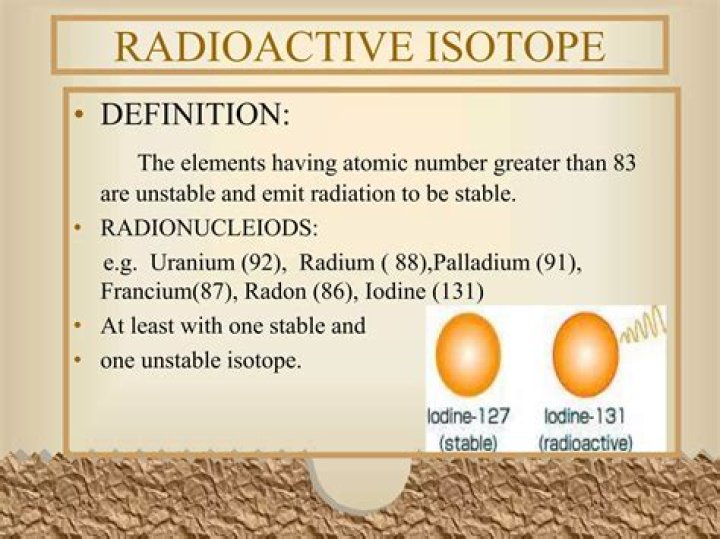
An unstable isotope is one that does undergo spontaneous nuclear decay. Unstable isotopes are also referred to as radioactive isotopes, or radiosotopes, or radioactive nucleides, or radionucleides.
What types of isotopes are unstable?
Radioactive isotopes are unstable because they have too many electrons. Many elements have one or more isotopes that are radioactive. These isotopes are called radioisotopes. An example of a radioisotope is carbon-14.
Is oxygen stable or unstable?
One oxygen atom is unstable since it has only 6 electrons in the outermost shell. For an atom to be stable it needs 8 electrons. So, for the oxygen atom to be stable it requires two more electrons in the valence shell.
What is a stable vs unstable isotope?
A stable isotope is one that does not undergo spontaneous nuclear decay. An unstable isotope is one that does undergo spontaneous nuclear decay.
What are 3 uses of radioisotopes?
Used in cancer treatment, food irradiation, gauges, and radiography.
Is Lithium stable or unstable?
Lithium is a relatively unstable element because its stable isotopes have a very low binding energy level. This means they are not prone to fission, which is breaking down. This is why, lithium is less common in the galaxy than some other elements with a higher atomic weight.