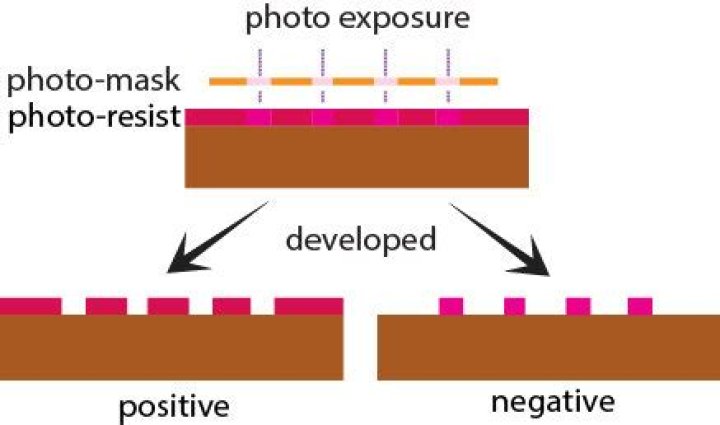
What is positive and negative photoresist?
Positive photoresists are able to maintain their size and pattern as the photoresist developer solvent doesn’t permeate the areas that have not been exposed to the UV light. With negative resists, both the UV exposed and unexposed areas are permeated by the solvent, which can lead to pattern distortions.
What is photoresist etching?
The photoresist serves as a masking layer for etching into the oxide. An acid etch is used to remove the oxide in the exposed regions, transferring the pattern to the oxide layer.
What is meant by photoresist?
Definition of photoresist : a photosensitive resin that loses its resistance to chemical etching when exposed to radiation and is used especially in the transference of a circuit pattern to a semiconductor chip during the production of an integrated circuit.
What material is photoresist?
polymer resins
Photoresist materials are polymer resins that contain photoactive (light sensitive) compound (PAC) and an alkaline-soluble resin. Present-day photoresist and photoetching processes evolved largely from technology developed in the print ing industry.
What chemicals are in photoresist?
Overview and Evolution of Silicon Wafer Cleaning Technology Photoresists are essentially hydrocarbon polymers composed of a novol-ack resin, a photoactive compound and an organic solvent.
What is lift off process?
INTRODUCTION. Liftoff is a cleanroom process used for applying a patterned thin film on your substrate surface. Liftoff is done by performing photolithography on your wafer before performing a deposition (such as sputtering) and then removing the photoresist with a chemical etch.
What is etching in VLSI?
In semiconductor device fabrication, etching refers to any technology that will selectively remove material from a thin film on a substrate (with or without prior structures on its surface) and by this removal create a pattern of that material on the substrate.
How is photoresist applied?
Spin coating is the most common method for applying photoresist to a substrate surface. In a typical spin coating process, the photoresist is applied to the center of rotating wafer and the spin speed is then increased rapidly to spread the resist evenly from the center to the edges.
What are the three major components of a photoresist?
The conventional positive photoresist has three major components: a photosensitive component called the photoactive compound (PAC), a novolak resin to provide structural stability and etch resistance, and a solvent which puts the solid photoresist into liquid form for the purpose of coating a substrate.