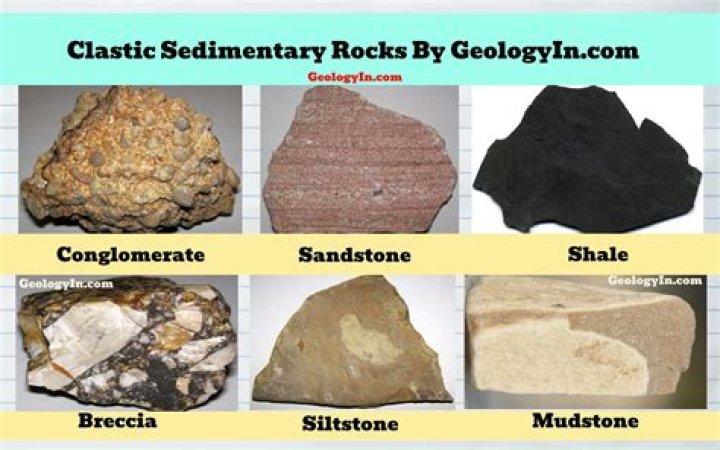
Which sedimentary rock is fissile?
Mudrocks are fine grained sedimentary rocks consisting of mostly silt and clay size fragments. They are sometimes called argillites….
| Grain Size | >2/3 silt |
|---|---|
| Description | Abundant silt sized grains visible with a hand lens |
| Fissile Rock | Silt-shale |
| Nonfissile Rock | Siltstone |
Is claystone a sedimentary?
By definition, claystone is a clastic type of sedimentary rock. It chiefly consists of fine particles of less than 1/256mm size, which are cemented into hard rock. In general, people use mudstone, siltstone/shales, and claystone terms interchangeably.
Is Marl a sedimentary rock?
A sedimentary rock containing a mix of clay and calcium carbonate. Compositionally, marls comprise 35% to 65% clay and 65% to 35% calcium carbonate.
Is claystone a shale?
(see chart below). Shales, mudstones and claystones are rock types that are very similar to each other. Siltstone – greater than half of the composition is silt-sized particles. Claystone – greater than half of the composition is clay-sized particles.
Which mineral is fissile?
The principal fissile materials are uranium-235 (0.7 percent of naturally occurring uranium), plutonium-239, and uranium-233, the last two being artificially produced from the fertile materials uranium-238 and thorium-232, respectively.
What does fissile mean?
Definition of fissile 1 : capable of or prone to being split or divided in the direction of the grain or along natural planes of cleavage fissile wood fissile crystals. 2 : capable of undergoing fission.
What does claystone feel like?
We cannot see the difference between these rocks, but it turns out that siltstone feels gritty when nibbled or rubbed against a tooth whereas claystones feel smooth. If you find a claystone, you know that it accumulated in a very quiet environment with almost still water.
What does marl look like?
Marl is usually pale grey or white; it can be formed under marine or more commonly freshwater conditions. A calcium-carbonate rich mud containing variable amounts of clays and silt. This may be defined either as calcite-mud or lime-rich silicate-mud depending on the proportion of carbonate to clay.
Where are marls deposited?
Where is Marl Located. Marl as lacustrine sediment is common in post-glacial lake-bed sediments, often found underlying peat bogs. It has been used as a soil conditioner and acid soil neutralizing agent.
Can shale be turned into clay?
Uses of Shale Black shales contain organic material that sometimes breaks down to form natural gas or oil. Other shales can be crushed and mixed with water to produce clays that can be made into a variety of useful objects.
What makes fissile?
A nuclide that is capable of undergoing fission after capturing either high-energy (fast) neutrons or low-energy thermal (slow) neutrons. Although formerly used as a synonym for fissile material, fissionable materials also include those (such as uranium-238) that can be fissionedonly with high-energy neutrons.